Friends,
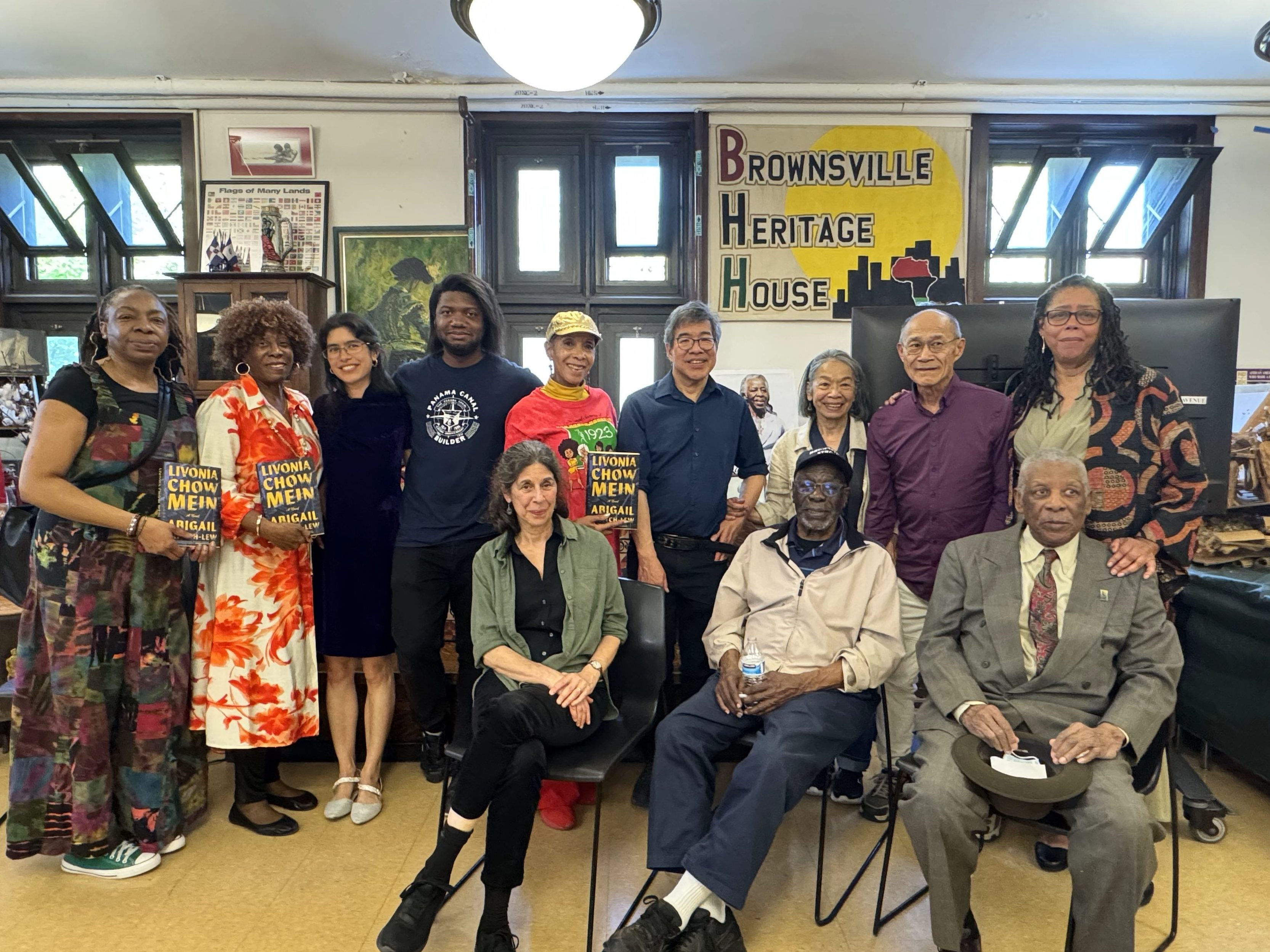
On Saturday afternoon, over 50 people gathered in Brownsville, Brooklyn for an event that used Livonia Chow Mein as a launching pad for a community dialogue about Black-Asian relations.
The event took place at the Brownsville Heritage House, in the care of the House’s generous director, Miriam Robertson. I co-facilitated the discussion with Reverend Cathie Wright Lewis—Brownsville novelist and Director of the Power in the Pen Writing Workshop, which meets regularly at the Brownsville Heritage House. Yellow Peril Books sold Livonia Chow Mein and hosted a book-signing table.
I am grateful to every person who braved the rerouted train lines and Brooklyn marathon street blockades to get there, as well as to my Power in the Pen Writing Workshop family, who held me every step of the way. There was so much love in the room, and people shared hard stories—stories of times they’d been hurt or misjudged—while still bringing a lot of care and tenderness to the space, a willingness to listen and learn.
Some stories we heard:
- One Asian American participant described how, growing up, he helped support his family by selling bootleg products on Canal Street—alongside Jamaican and Ghanaian vendors—to affluent white visitors. The relationship between these communities of vendors was sometimes tense, but they were also able to come together in solidarity against Guiliani-era police abuse and government crackdowns.
- One Black Brooklynite of Caribbean/South American descent discussed the extremely competitive process of applying for New York’s specialized high schools, and the disparities in access to test preparation that continue to exist in NYC (note: Last fall, just 3% of offers at the city’s specialized high schools were offered to Black students; 54 percent went to Asian American students). She also described how painful it was to see non-Black peers disparage Affirmative Action policies and refer to Black friends as undeserving of their success—especially when some of those same non-Black peers were themselves engaged in cheating or possessed other unearned advantages.
- One Chinese American older adult described his experiences growing up in the segregated American South, how his family got away with using the “whites only” bathrooms, which were better kept—(perhaps, I would think, because the government actually cared to clean them)—his awakening during the Vietnam War era to the importance of solidarity between Black and Asian Americans, and his many decades of work in New York City to build bridges between our communities.
- Three women—of Black, Caribbean, and South American heritages—described their positive associations with Asian vegetable markets and visiting Chinatown. Especially for Caribbean residents, these vegetable markets were often some of the only places they could go for fresh vegetables from their home countries.
- One Black Brooklynite described how, when buying vegetables at a Chinese market in Sunset Park, an Asian customer approached her to ask why she was shopping there. The storyteller said she felt hurt and offended, and answered, “I’m here for the same reason you are here.” The storyteller acknowledged that it’s sometimes hard to tell when people approach out of genuine curiosity or out of a racist, exclusionary mentality.
- One Black Brooklynite described how growing up, his local Chinese restaurant accepted his family’s food stamps, though it didn’t have to. At school, he ended up befriending a young, bullied Chinese boy who happened to be the child of the restaurant owners—a full circle moment of friendship and solidarity. He told a second story of visiting some Chinese American friends at their home, and watching his friend stand up to his own mother’s anti-Black racism. Their friendship continued because of the son’s willingness to challenge his mother’s bigotry.
Here are some stories and thoughts that were shared privately, via index card:
“My grandmother was very involved in the Teachers Union (UFT) and started a then “Afro-American Heritage Festival” to celebrate Black History Month. With the group of mostly Chinese and Asian teachers, they created a similar celebration for Asian culture and history. The UFT then provided a trip to Taiwan for teachers to learn about the educational system and cultural exchange, which my grandmother and mother attended. So we grew up as children in a Black family, learning about commonalities between our communities more than difference.”
“I’m Chinese American and I moved to Manhattan Chinatown in March 2020. Before there was a Covid vaccine, while Chinatown was a ghost town and the few people out and about were all masked, I got on the train to see a doctor. A Black woman came to stand next to me because I was sitting by the doors and she was about to get off. To maintain social distancing, I slid down the subway bench quite far from her. She was incensed and let out a prejudiced rant that my people were the ones who brought the virus over, and that she was far more likely to get it from me than I was from her. She was so angry and hateful, berating me for what seemed like an eternity, with all the other passengers witnessing, but no one stood up for me, so it felt like they agreed with her rant. I felt so humiliated as I cried and cried until it was my stop. But Abby, what you said about how unhealed trauma causes people to hurt others—I feel more compassion for this woman now, and I understand that some extremely hurtful experiences or propaganda might have been at the root of her anger and the way she treated me. She almost certainly has had a harder life than my privileged one. I hope she is well and has found some peace.”
“Honarary whiteness is a factor in the white supremacist structure of the U.S. government, and mainstream society.”
“I think one of the ways we can continue to heal and build solidarity in interracial communities is acknowledge harm, find joy in our interactions with each other, and come together and be there for each other in times of pain.”
“I suggest that Livonia Chow Mein go on a public school book list to engage our youth about true multiculturalism. This can provide an opportunity to have our youth have open dialogue and learn about one another.”
“I am blown away by the powerful, deep-varied stories shared in this safe-quaint-unassuming space of honest-authentic reflections that give us hope. We are all basically the same, wanting free-respectful-loving space to live comfortably without fear of shackles & mistrust!”
My takeaways from the evening:
I am myself learning how to be a facilitator of these conversations. To respond to someone’s words immediately—with care and with critical feedback—is very challenging for me; I’d much rather take twelve years to draft a written response! But I hope to get better at this work, because it’s for this work that I wrote the book—to create space for difficult conversations, to inspire people to share their own stories, and to assist them in analyzing their experiences from new perspectives.
I think everyone brought their best, most compassionate selves to the room. I also think that generational differences and differences in the experience of being racialized can mean that certain comments sit differently for different people. For instance—and reader, tell me if you think differently!—I’ve noticed that older generations, across race, are used to saying the phrase “the Blacks,” but this phrase often doesn’t sit right for younger Black people, especially if it’s coming from a non-Black person (there’s a preference for “Black people”—for language that doesn’t essentialize). Another example: when Black people share how much they love Chinese food—as a way to compliment and honor Chinese culture—it’s not uncommon for a Chinese American person to secretly think, “thank you, but for decades there were only two occupations available to us—the laundry business and restaurants. We’re more than our food, I promise.” When we live segregated from each other—and, as Mama Cat pointed out, immersed in propaganda—we are more likely to speak in ways that hurt each other, unintentionally.
All of which is to say, I hope to host more of these gatherings, and next time, I hope to be more successful at conducting outreach to non-English speaking residents. I also hope to create time for not only storytelling, but also discussion of the stories and scenarios that people bring to the table.
More to come!


Leave a Reply